
We Didn’t Have the Language Then (Part 2)

Updated: Jul 7

I’ve been thinking a lot lately about how much language shapes what we’re able to see. My mother died last year. At the time, I didn’t have a concept of ADHD beyond the stereotypes most of us were taught, restless boys, school struggles, something loud and obvious. That wasn’t my mother. If anything, she felt like the opposite.
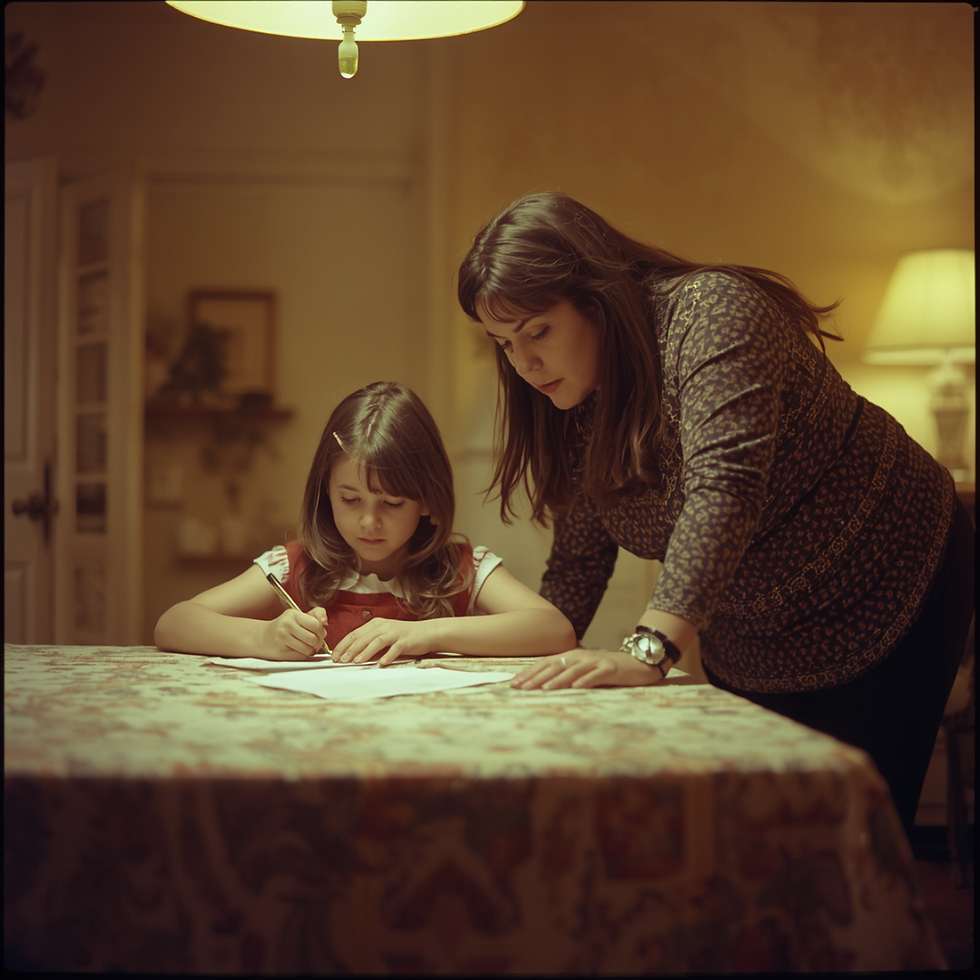
I was the eldest of four children. I remember her, in my early years, as distant in a way I couldn’t quite name. Not absent exactly, she was there, but not reachable. Later I would describe it as “zombie”.
It wasn’t said aloud. It wasn’t something I would have had words to explain. But that’s how it felt to me: as though she moved through the house without presence, without responsiveness, without that sense of attunement I saw in other families. I didn’t understand it then. I don’t think I really understood it as an adult either, even once I had children of my own. Because becoming a parent made it more confusing, not less.
I found myself asking questions I could never resolve:
Why didn’t she step in more?
Why didn’t she protect us in ways that now felt obvious to me?
Why didn’t she seem to notice what was happening, or how we were feeling?
There were other dynamics in our home that shaped things too. My father struggled with alcoholism, and there were times the environment didn’t feel safe. I name that because it mattered. It shaped what all of us learned to do to cope. But it’s not the only story here and not the one I’m trying to understand in this piece of writing.
My mother and I weren’t estranged. We were cordial. But we weren’t close. I didn’t go to her for advice. I didn’t seek her out for comfort. Physical affection felt awkward and unnatural between us.
There wasn’t hostility in an overt way, just a quiet disconnection that stretched across decades. I adapted to that long before I could understand it.
There were other dynamics in the family that complicated things further. I was my father’s “favourite” and it wasn’t the kind of favouritism that felt safe or easy. It created an imbalance that made it harder, not easier, to find my place with my mother. I didn’t have the words for any of this at the time. I just knew that something didn’t fit.
Now, looking back from where I am, I’m aware that I’m holding pieces of a puzzle I didn’t have access to then. In the past year, particularly through understanding ADHD more deeply, I’ve found myself revisiting those early experiences with new questions. Not conclusions. Questions.
Because what I’ve come to understand is that ADHD doesn’t only look like restlessness or chaos. It can also look like:
overwhelm that leads to shutdown
difficulty initiating or sustaining engagement
emotional disconnection as a form of coping
being physically present but cognitively elsewhere
struggling to respond in the moment, even when care is there
And importantly, for many people of my mother’s generation, there was no framework to understand any of this. What might now be recognised as neurodivergence was often interpreted as personality. Or character. Or failure. Or simply … the way things were.
I don’t know if my mother had ADHD. I can’t know that, and I don’t need to. But I can see patterns now that I couldn’t see before. And I can feel something alongside that recognition that I didn’t have access to when she was alive. Not forgiveness. Not resolution. But a kind of layered grief.
Grief for the relationship we didn’t have. Grief for how alone I felt in her presence. Grief, now, for what she may have been living with internally, without language, without support, without understanding. And perhaps most of all, grief that we didn’t have a shared way of making sense of each other while there was still time.
Being a parent myself hasn’t resolved that grief. If anything, it has made parts of it sharper. There have been moments with my own children where I can feel how much intention sits behind something as small as noticing, responding, stepping in, staying present when it would be easier to drift away. And it leaves me holding a question I don’t fully know how to answer: what gets in the way of that, when someone wants to be different? I reflect on my parenting: what familial patterns have I altered and what patterns continue, unseen?
Understanding something later doesn’t rewrite what it felt like then. The absence of connection was real. The confusion was real. The adaptations I made as a child were real. Those don’t disappear just because new explanations become available.
But something softens when the story shifts from: “Why was she like that?”to “What might have been happening that neither of us understood?”
This is not a story about diagnosing a parent after the fact. It’s about noticing patterns, and what it means to revisit a relationship once new language becomes available. It’s about holding two truths at once. That something was missing. And that there may have been reasons for that absence that were never named.
If any of this resonates, you don’t have to decide what it means. You don’t have to reinterpret your whole past. You don’t have to feel compassion if what’s present is anger, or numbness, or nothing at all.
Sometimes the first step is just noticing:
What was there.
What wasn’t.
And what, perhaps, none of you had the words for at the time.
I’m still learning how to hold this story not as a fixed truth, but as something that can be seen from more than one angle, depending on where I’m standing.
Previous post: A reflective series on family and missed ADHD (Part 1)
Next in series: Not a Symptom List: How ADHD Shows Up as a Life Pattern (Part 3)
Looking to explore family patterns? ADHD Family Patterns Map


Comments