
Grieving the Parent You Had, and the One They Might Have Been (Part 8)

Updated: Jul 8
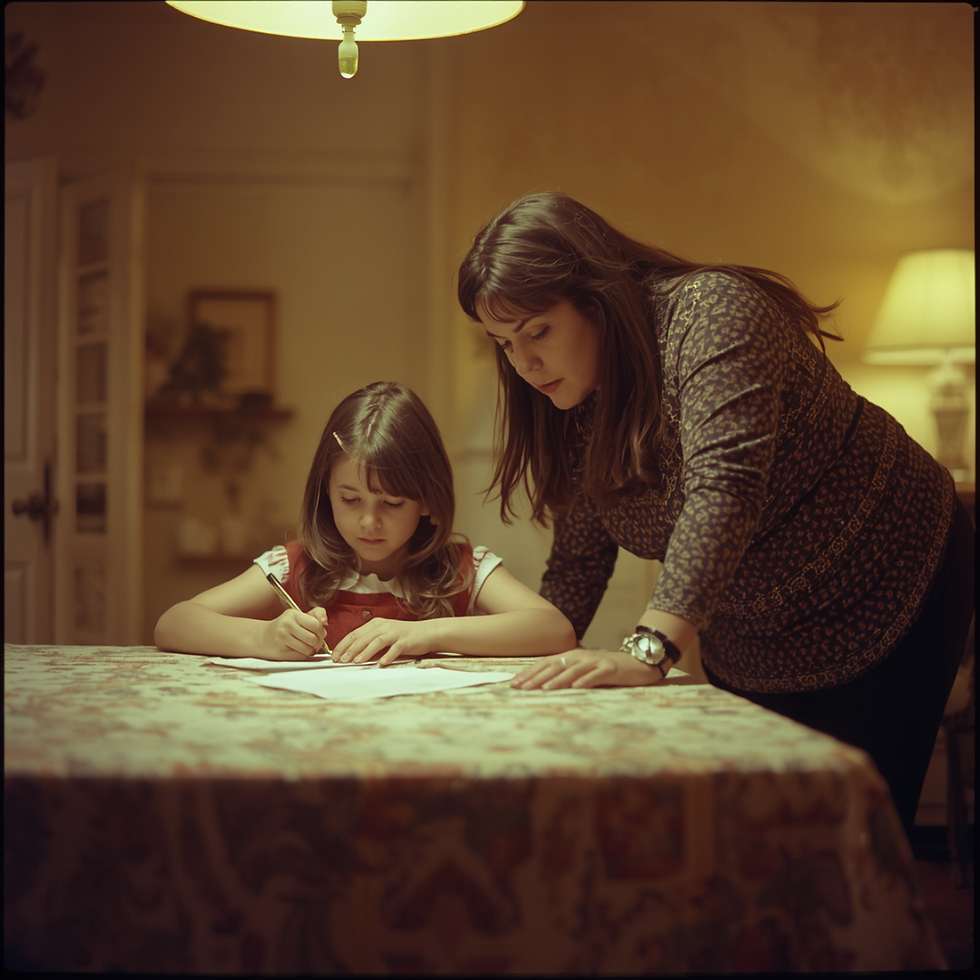
There’s a particular kind of grief that comes with understanding something too late. Not late in a practical sense, but late in a relational one. After the conversations that never happened. After the questions you didn’t know to ask. After the chance to see each other differently has already passed.
My mother died before I had the framework I have now. Before I had language that might have helped me make sense of what I experienced and perhaps, in some way, what she was experiencing too. I don’t know what we would have done with that language, if we’d had it. I don’t know if it would have changed anything.
But I still find myself grieving that we didn’t have the opportunity to try.
For a long time, the grief I associated with my mother was relatively contained. It sat mostly in the space of what I didn’t have. The closeness. The ease. The sense of being known and responded to. It was a grief I had already, in some ways, adapted to while she was still alive. What has shifted more recently is the shape of that grief. It feels less singular now. More layered.
There is still the grief of what was missing. That hasn’t changed. But alongside it, something else has emerged. A quieter, less defined grief. Grief for what may have been difficult for her in ways I didn’t understand. Grief for what it might be like to move through your life without language for your own internal experience. Grief for what it costs someone to keep going under those conditions.
This isn’t a replacement for the first grief. It doesn’t cancel it out. It sits beside it.
And sometimes those two forms of grief don’t feel compatible. There are moments where I feel a kind of softening toward her, a sense that her distance may not have been as simple as I once believed. And then there are moments where the original feelings return just as strongly: the sense of being alone, the confusion, the lack of connection
Both are true. And they don’t resolve into each other. I think, for a long time, I held an unspoken expectation that understanding would lead to clarity. That if I could just find the right explanation, the emotional landscape would settle. But that’s not what’s happened. If anything, understanding has made the emotional landscape more complex.
Because now there is more to hold. Not less. There is the child who adapted to what wasn’t there. There is the adult who can now see patterns that were invisible at the time. And there is the awareness that something may have been happening for her that I was never able to access. None of those cancel each other out.
Grief, it turns out, is not just about loss. It’s about holding all those perspectives without being able to collapse them into a single, coherent story.
There’s also a different kind of grief that comes into focus when understanding comes later.
The grief of what might have been possible. Not in a grand or dramatic sense, but in smaller, quieter ways. Maybe we would have had different conversations. Maybe I would have interpreted her differently in the moment. Maybe I would have asked questions instead of withdrawing. Maybe she would have felt less alone in herself. Or maybe none of that would have happened. There’s no way to know. And that’s part of the grief too.
Becoming a parent has made this sharper in some ways. Because I can feel how much is happening, moment to moment, in a relationship between parent and child. How many small interactions shape the overall sense of connection. How much gets built, or not built, over time.
It makes the absence of that feel more tangible. But it also makes me aware of how fragile these relationships can be. How dependent they are on things we don’t fully control: capacity, support, language, timing. That awareness brings its own kind of humility.
I don’t find myself wanting to rewrite the past or to turn my mother into someone she wasn’t. But I do feel a kind of sadness that sits in a different place now. Less sharp in some moments. More expansive in others.
A sadness that includes both of us. Not just what I didn’t receive, but what we may both have been navigating without the tools to name or change it.
I think there is a temptation, when new understanding comes, to try to arrive somewhere clean. To land on a version of the story that feels resolved. But this doesn’t feel like that kind of story. It feels more like something I move around in. At different times, from different angles. Sometimes I feel closer to the child’s experience. Sometimes closer to the broader understanding. Sometimes somewhere in between.
There isn’t a single place to stand and maybe there doesn’t need to be. For now, it feels enough to allow the grief to be layered. To not rush it into forgiveness, or closure, or a more palatable version of the past. Just to let it exist as it is: complex, unfinished, containing more than one truth.
If you’re sitting with something similar, a relationship that makes more sense now than it did then, you might notice what comes up alongside that understanding. Not just insight but feeling. Grief doesn’t always arrive all at once. Sometimes it unfolds as understanding grows. You don’t have to resolve it. You don’t have to make it neat.
Sometimes it’s enough to let it be what it is, in this moment.
Previous in series: Inheritance without blame (Part 7)
Next in series: Understanding Without Obligation (Part 9)
Looking to explore family patterns? ADHD Family Patterns Map


Comments