
Surviving Isn’t Free: When Coping Becomes a Personality (Part 4)

Updated: Jul 7

As I’ve been reflecting on my mother over time, one of the shifts that’s hardest to articulate is this: what I once understood as personality, I now find myself wondering about as coping. Not in a way that replaces everything I thought before, but in a way that sits alongside it, quietly changing the shape of it.
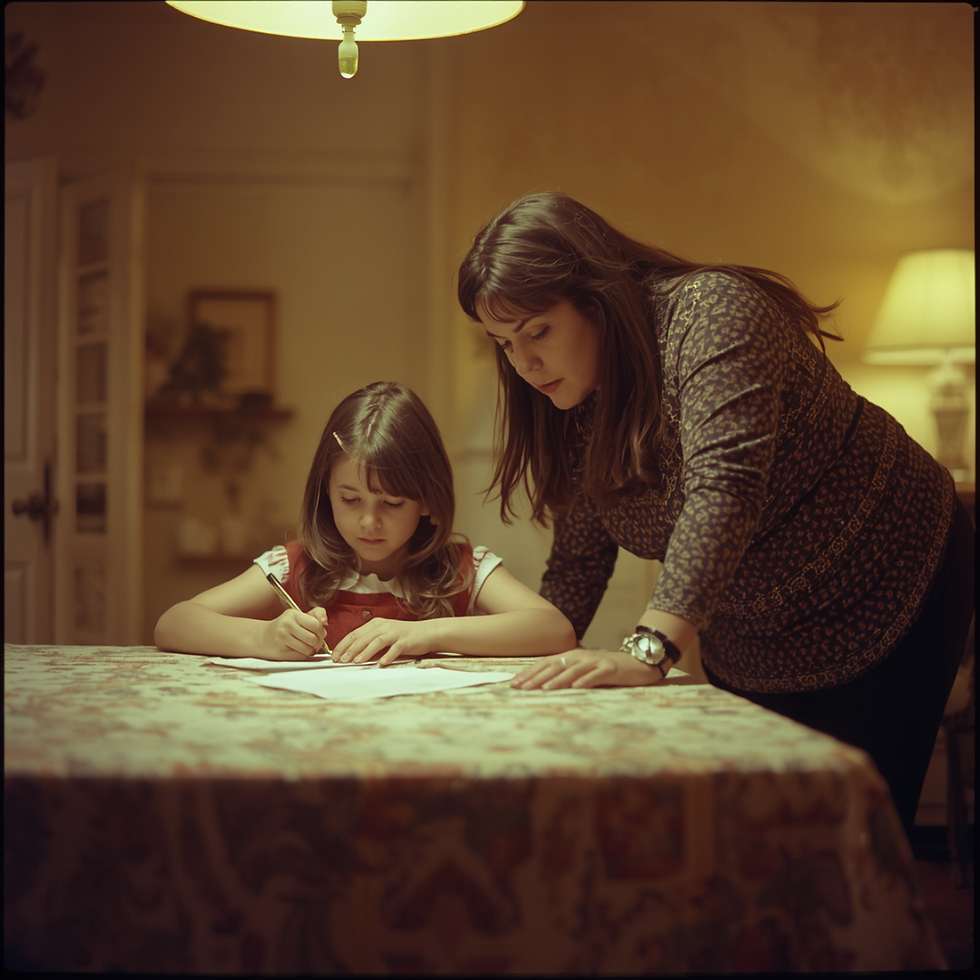
Growing up, I didn’t think of my mother as someone who was overwhelmed. I thought of her as someone who was withdrawn. Flat. Not particularly interested. That’s how it looked to me as a child. There was a stillness about her that I interpreted as absence, not just physical, but emotional. As though she had stepped back from the world a few degrees and stayed there. I didn’t ask what that might cost her. I experienced what it cost me.
But distance, I’m beginning to understand, is not always indifference. Sometimes it’s what happens when being fully present is too much to sustain.
In the framework I have now, I find myself wondering about the possibility of chronic overwhelm, the kind that doesn’t show itself in obvious chaos, but in quiet shutdown. Not being able to track everything that’s happening. Not being able to respond in the moment. Not knowing where to begin, so not beginning at all. And over time, perhaps, learning that the only way to manage that is to narrow your world. To reduce what you take in. To move more slowly. To disengage just enough that things feel manageable again.
From the outside, that can look like passivity. Or disinterest. Or even neglect.
From the inside, it might feel very different. But I didn’t have access to her internal world. I only had access to what reached me.
There were things she didn’t do that stand out more clearly to me now than what she did. She didn’t step in quickly. She didn’t intervene often. She didn’t track the emotional temperature of the room in the way that I now instinctively expect from a parent. And in a home that could already feel unpredictable at times, that absence of response carried weight.
As a child, I didn’t think, this is someone coping within their limits. I thought, this is someone who isn’t showing up.
Over time, I adjusted to that. I became more self-sufficient. More watchful. Less likely to expect support. And eventually, those adaptations stopped feeling like adaptations at all. They just felt like who I was.
This is the part that feels important to name clearly. Even if something is a coping strategy, it still shapes the people around it. It still creates an environment. It still leaves an imprint. Understanding that someone was overwhelmed does not undo what it was like to be a child inside that overwhelm.
There were other pressures in our home too. My father’s drinking meant the atmosphere could shift quickly, sometimes without warning. There were moments that didn’t feel safe, even if I didn’t fully understand why at the time. And in that context, the absence of a consistent, grounding presence was felt even more sharply. Not as a dramatic lack, but as something quieter, no one fully holding the centre.
I sometimes catch myself wondering what it felt like for her, in the middle of that. Not in a way that replaces my own experience, but in a way that sits beside it. What does it take to move through a day when everything feels harder to organise, harder to initiate, harder to sustain? What does it mean to be responsible for a family in that state?
I don’t have answers to those questions, but I notice the questions themselves are different from the ones I used to ask. They don’t erase anything. They don’t resolve the past. But they shift me, slightly, out of a single story.
Becoming a parent has complicated this further. Because I know, in my own body, what it takes to keep showing up, to stay responsive, to notice, to intervene when something isn’t right. It’s not effortless. It requires energy, attention, and a kind of ongoing regulation. And there are moments, even now, where I can feel how easy it would be to drift, to miss something, to respond later than I should, to not quite stay with what’s happening. The difference, for me, is not perfection. It’s awareness. And support. And language. Things she may not have had access to.
Still, knowing that doesn’t change what it felt like to be on the other side of it. To wait and not be met. To need something and not receive it. To learn, slowly, that it was easier not to need at all.
This is the tension I find myself holding, that what looked like personality might, in part, have been survival. And that survival, even when necessary, is not free. It costs something. Sometimes it costs connection.
I don’t know exactly how to integrate that yet. But I’m beginning to recognise that understanding coping is not about softening everything into something acceptable. It’s about seeing more clearly what was happening, including the constraints, without losing sight of the impact.
If anything, it makes the story feel more human. Less about who was right or wrong.More about what was possible, and what wasn’t, given the capacities and circumstances that were there. And maybe that’s the beginning of something, not resolution, but a kind of honesty that can hold more than one truth at the same time.
You might notice, in your own story, moments where something felt like personality at the time. And you might gently ask:
What might that have been protecting?
And what did it cost the people around it?
You don’t have to answer. Just noticing is enough, for now.
Previous in series: Not a Symptom List: How ADHD Shows Up as a Life Pattern (Part 3)
Looking to explore family patterns? ADHD Family Patterns Map


Comments